ORIGINAL FRAMEWORK · ADAPTAWIZ · VAL FRASER
The Ethical Doppler Framework
A decision-governance framework for leaders who make choices that travel and ripple through organisations, communities, and futures they may never see.
THE CONCEPT
Decisions that travel
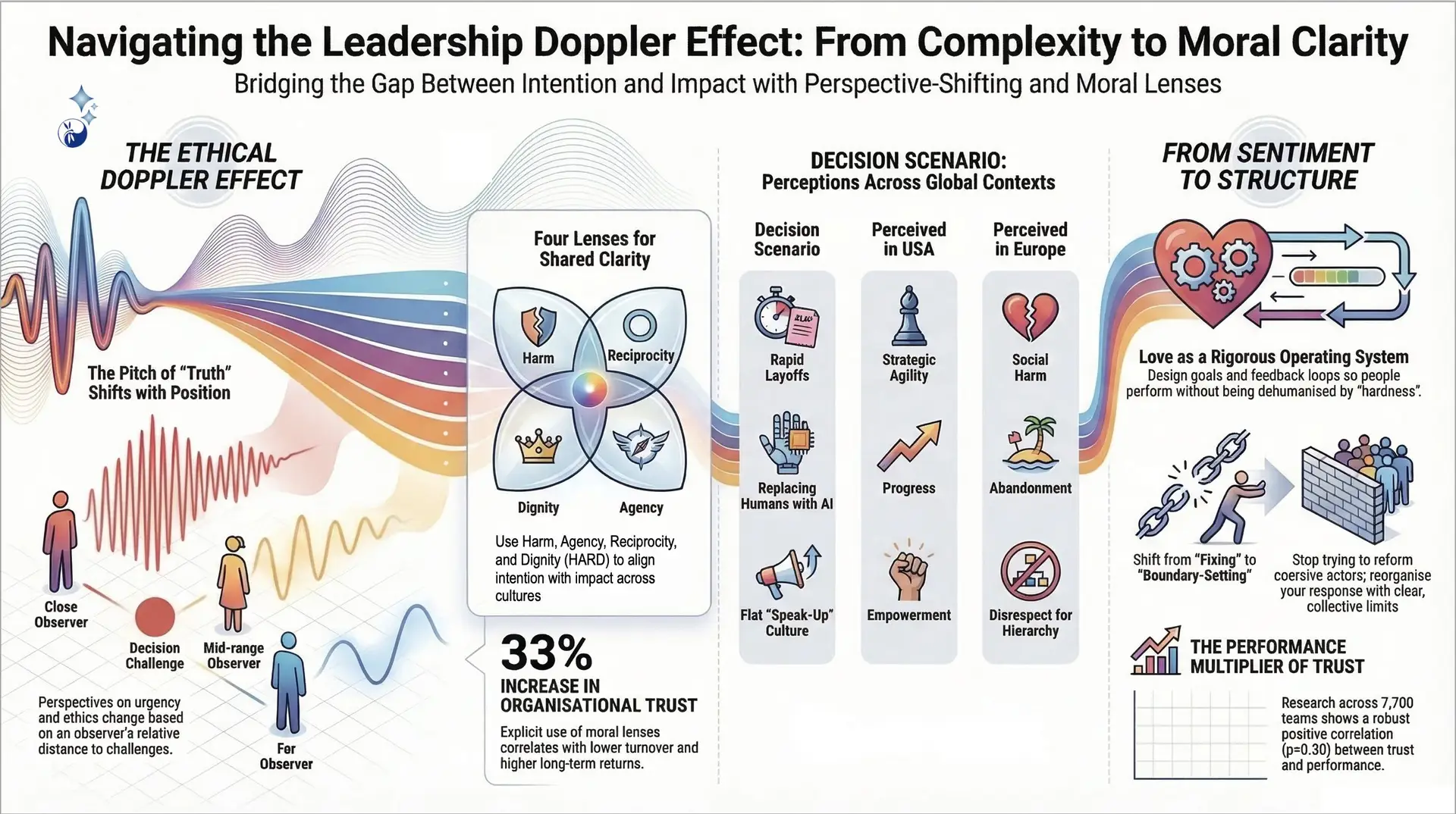
The Doppler effect describes how a signal’s frequency changes as it moves through space. Leadership decisions work the same way. They are made in one context but experienced in many others, often at a completely different frequency from the one intended.
It starts from a systemic question: who is this decision really for, and who else will feel its effects? It treats every significant decision as something that will travel across teams, hierarchies, borders and time, shifting meaning as it goes. The framework helps you test the gap between what you intend and what others will experience.
A restructuring decision made in a boardroom is experienced as a threat at the team level. A resource allocation made for operational efficiency is received as abandonment by those in the field. A policy designed to protect is perceived as controlling by those it governs.
The Ethical Doppler Framework gives leaders a structured way to audit decisions before they travel. It doesn’t eliminate all risk, but allows you to see more of what you cannot yet see.
Why this framework is different
Most leadership and coaching models help you clarify goals, improve performance, or adapt your style. Ethical Doppler focuses on something else: the gap between what you intend and what others actually experience, especially when decisions travel across teams, borders, and time. It does not replace those models; it sits on top of them as a decision‑audit, helping you test whether a course of action still holds up once you consider harm, agency, reciprocity, and dignity across the wider system.
It builds on systemic, outside‑in ways of looking at teams and stakeholders, and applies them specifically to the ethical impact of leadership decisions in complex systems. Instead of prescribing a “right” answer, it gives you a disciplined way to ask: who is harmed, whose agency narrows, where reciprocity breaks, and whose dignity is at risk when this decision leaves the room.
THE FOUR LENSES
HARD — the governance you owe every decision
Each lens surfaces a different category of consequence that leaders routinely miss under pressure, complexity, or cognitive overload.
H
HARM
Who or what could be damaged by this decision: including people not in the room, systems not yet visible, and futures not yet mapped? Harm includes physical, psychological, relational, reputational, and structural damage.
- Who is not in this room whose safety depends on this decision?
- What does this decision make harder, smaller, or invisible for someone downstream?
- What harms are we treating as acceptable because they are inconvenient to measure?
A
AGENCY
Who gains or loses the ability to act, choose, or influence as a result of this decision? Agency is not simply about autonomy: it includes access to information, the ability to dissent, and the capacity to recover from being wrong.
- Does this decision expand or contract the meaningful choices available to others?
- Who is being asked to comply without being given the full picture?
- What structures would allow the people affected to challenge or shape this?
R
RECIPROCITY
Is the exchange of value, risk, and responsibility fair? Reciprocity breaks down when decisions extract effort, loyalty, or sacrifice from one group while concentrating benefit in another. Particularly when that asymmetry is invisible to those giving.
- Who is carrying the risk of this decision without carrying the reward?
- What are we asking of people that we would not be willing to give in return?
- Where is loyalty being leveraged rather than earned?
D
DIGNITY
Does this decision treat people as ends in themselves, or as means to an organisational end? Dignity is often the first casualty in high-pressure environments, where urgency overrides humanity, and the last thing anyone names until it has already been lost.
- How does this decision communicate what we believe about people’s worth?
- Are we treating the people most affected as authors of their situation, or as objects of our solution?
- What story will the people affected tell about how this was handled?
HOW TO USE IT
A structured practice, not a one-time checklist
For consequential decisions, take a moment to contract the field of your Ethical Doppler audit and make the purpose, scope, and stakeholders explicit before you begin. Clarify its purpose (“Are we using this for learning, governance, or formal due‑diligence support?”), its scope (“What part of this decision are we examining?”), and its stakeholders (“Who is directly and indirectly affected? Who can block, enable, or reinterpret this?”). This ensures you are not auditing the decision only from the vantage point of the people in the room.
01
Name the decision clearly
Before applying any lens, write the decision in a single sentence. Decisions that cannot be named clearly are not ready to be made. Including who they are for and who will live with their consequences. The naming step alone surfaces assumptions and reveals the true level of consensus in the room.
02
Apply each lens systematically.
Work through Harm, Agency, Reciprocity, and Dignity in sequence. Do not collapse them; each surfaces a different category of consequence. If a lens yields no responses, that is itself significant: it may signal a blind spot rather than safety. Where possible, answer each lens not only from your own role, but from the perspective of at least one stakeholder who is directly affected and one who is further downstream.
03
Stress-test your responses
For each lens, identify who was not in the room when you answered, including those you agreed in advance were ‘in scope’ for this decision. Ask how your responses would change if that person were present and had an equal voice. The Ethical Doppler effect is most active in the gap between who makes a decision and who lives with its consequences.
04
Decide, act, and review the signal
Apply what you have learned and proceed. Then, at a defined point after implementation, revisit each lens. How did the decision travel? What frequency did it arrive at, compared to the one you intended? This review builds institutional wisdom over time.
WHO TO USE IT WITH
Used with teams, not just individuals
Working with teams and stakeholders
An individual leader can use ethical Doppler. However, it is strongest when applied together with the people who share responsibility for the decision, and where possible, a representative or those most impacted by the consequences. In systemic team coaching, this is called “working from the outside‑in”: letting the wider system and its stakeholders help shape how you read harm, agency, reciprocity, and dignity.
WHERE IT APPLIES
Any decision that travels beyond the room
Cross-border policy decisions · Research protocol ethics · Consortium governance · AI & technology deployment · Organisational restructuring · Resource allocation under pressure · Performance management · Cultural change initiatives · Stakeholder engagement strategy · Team composition decisions · Communication in complex environments · Leadership succession
Want to bring the HARD lenses into your leadership practice ??
The framework is most powerful when applied live, in coaching, team facilitation, or governance review.
A discovery call takes 30 minutes and costs nothing.
Download the free guide with seven questions that reveal what your decisions look like from the perspectives you cannot yet see.
Developed from practice in coaching, team facilitation, and governance contexts across European health and R&D organisations.
No spam. Unsubscribe at any time. Your information is never shared with third parties.
Val helped me become aware of things I simply could not see about my leadership, without ever making me feel judged. The process was both rigorous and deeply human.
HEAD OF UNIT
EUROPEAN UNION
I discovered Valerie in a team booster I organised within Airbus. She provided me her experience to hear from my team and to make all people more aware about their fears, weaknesses and most important on their strengths. She demonstrates an incredible energy, connection, which was a strong enabler to on onboard each individual in the exercises. […] her multi cultural experience is a strength for international companies.
HEAD OF HUMAN RESOURCES
EUROPEAN AERONAUTICS & SPACE